Your First Time · Minute by Minute
The Water Doesn't Care
That You've Never Skied.
Neither do we. Three thousand people have stood where you're standing — wondering if they could do this. They could. So can you.
Let's Be Honest
What's Really
Stopping You?
Everyone who's never waterskied has a version of these thoughts. They're normal. They're also wrong — here's why, one at a time.
“My first waterski experience was at age 15 and I got up on my first try. I was instantly hooked — it gave me a feeling of accomplishment.”
— Ken Nelson, who built this lake because of that feeling
“I'll embarrass myself.”
“I'm not fit enough.”
“Good skiers will be watching me fail.”
“It's going to hurt when I fall.”
“The water's probably freezing.”
“I don't want to waste the money.”
“I don't know anyone who does this.”
“My body. In a swimsuit. In front of strangers.”
Your Day
Minute by Minute.
No Surprises.
You drive down a gravel road and see a lake you didn't know existed.
Fifteen minutes from Edmonton International, tucked against the North Saskatchewan River valley. Park by the clubhouse. Take a breath. The lake is bigger than you expected.
Your coach walks you through everything before you touch the water.
Skis on your feet, rope in your hands, right there on the dock. You'll practice the body position, hear exactly how the boat will pull, and rehearse the stand-up before it happens. No jargon, no rushing — by the time you get in, you've already done it once on land.
Everything fitted, everything provided.
Life jacket (the fitted kind, not the floppy kind). Skis chosen for your size. Wetsuit when the season calls for it. Gloves for grip. You brought a towel and a swimsuit; that was the whole job.
The hardest part of waterskiing is eliminated completely.
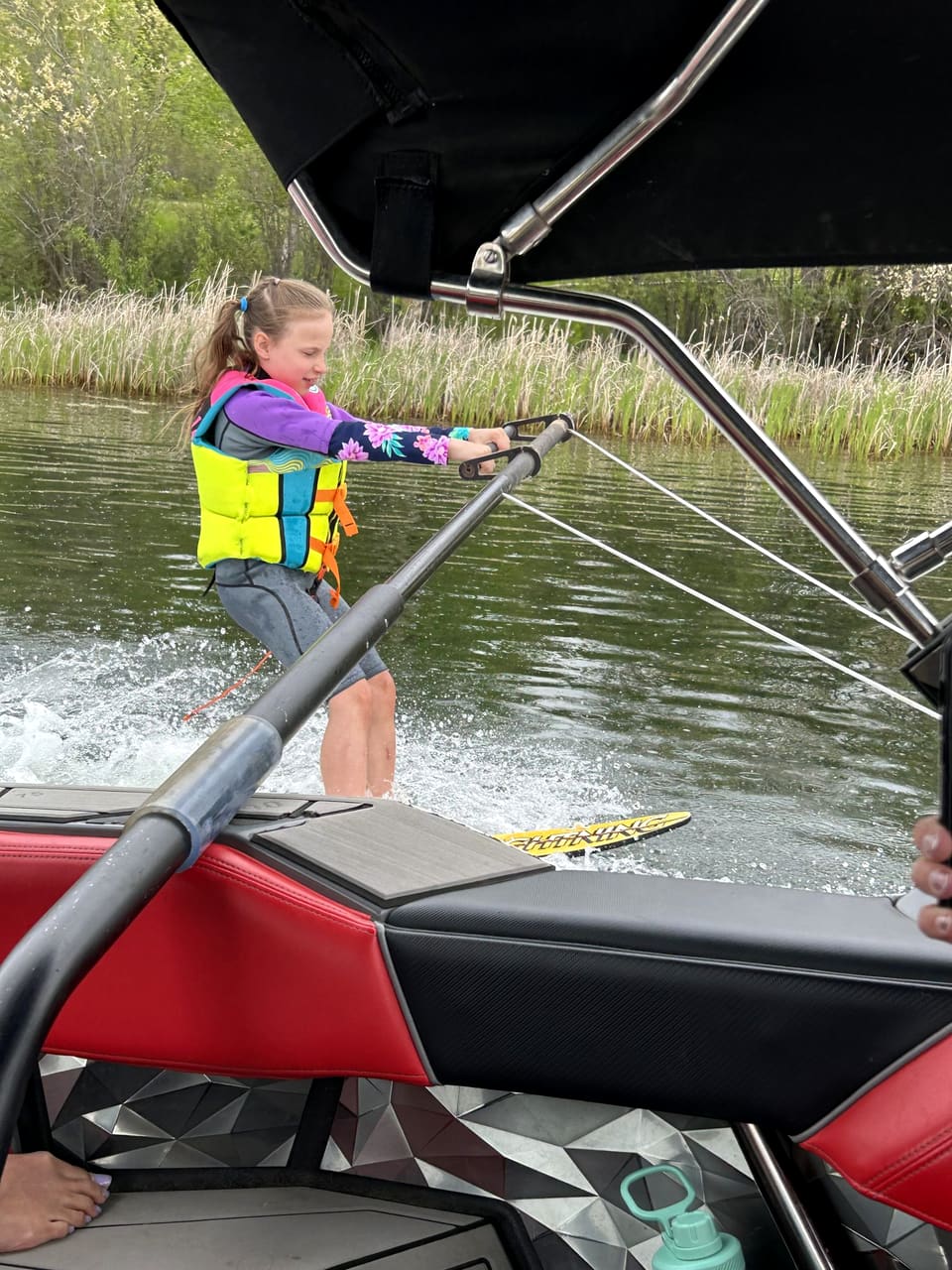
The boom is a rigid bar on the side of the boat. You're close to your coach, the speed is gentle, and the deep-water start — the thing that defeats everyone behind a family boat — simply isn't part of your first lesson. You hold on. You stand up. The boat does the work.
You're standing on the water.
Most people are up within minutes. Some take a few more — it doesn't matter. The moment the spray starts and the trees begin to move past you, every fear from the parking lot is gone. This is the moment. This is why three thousand people came before you.
You ski. You fall. You go again.
Your coach adjusts you run by run. You try crossing the wake. Maybe you fall — and discover it doesn't hurt. The jacket bobs you up, the boat circles back, and each run gets a little braver.
You sit on the dock and grin at the lake.
Fifteen minutes is enough to know. Most people are hooked and book their next set before they've dried off. The muscles you didn't know you had will introduce themselves tomorrow. That's normal. That's good.
After the First Set
Where It Goes
From Here.
Set two and three usually happen the same week — that's when the boom becomes a rope, and the rope becomes the open lake. From there: kids' programs, women's groups, set packages that bring the price down to $57, and — for the ones who catch the bug badly — the same slalom course the champions run.
It all starts with the same fifteen minutes.